

Reviewed · PRIVATE VIENNA CITY TOURS
Private Vienna Highlights History Walk — WWII and Post War Vienna
WWII echoes, but Vienna still sings. This private 3-hour walk ties the city’s turning points from the Second World War into the postwar era, with Belvedere views and hotel pickup that gets you moving fast. I especially like how the route balances big landmarks with human-scale places of memory, and I love the guide style, with names like Walter and Brigitte often praised for warmth, humor, and keeping the pace friendly for real people with real questions.
One thing to consider: it’s a walking-focused route, and the tour includes pickup but not hotel drop-off, so you’ll want to plan how you get back from the last stop.
Key highlights you will feel right away

- Private group up to 10: small enough for real conversation, not just following a ribbon of tourists
- Hotel pickup at 09:30 or 14:00: you start the day already in sightseeing mode
- A clear WWII to postwar story arc: from imperial power, to Anschluss-era propaganda, to memorials and recovery
- Short Ringstraße tram ride: see the rebuilt State Opera corridor without burning extra time
- Many free entry stops along the way: more time for looking, less time at ticket counters
- Guides who tailor the flow: flexibility is built in, and several guides are praised for doing just that
Only your group, at your own tempo
- Vienna: Private Walking Tour with a Local Guide★ 4.6 · 1,420 reviews
- Vienna: Private Walking Tour with a Guide★ 4.7 · 962 reviews
- Vienna: Wine Tasting Experience in a Private Wine Cellar★ 4.8 · 413 reviews
- Private Day Tour Trip Salzburg Hallstatt and Melk from Vienna★ 5.0 · 388 reviews
Why Vienna’s WWII-to-postwar route hits different

Vienna can feel like a postcard if you only skim the surface. This walk refuses that shortcut. The story is framed by power, propaganda, occupation, and rebuilding, but it still stays grounded in what you can see right now, the stone, the squares, the terraces, the courtyards, the corners where history leaves fingerprints.
The best part is that you do not just hear facts. You get a sense of how symbols work in a city. A palace terrace becomes a viewpoint on a political shift. A war memorial becomes an uncomfortable reminder that “liberation” can live alongside occupation in the same memory. Even a church burned during the war turns into a quiet lesson in how fragile daily life can be when looting and chaos take over.
And because this is private, your guide can steer the emphasis toward what you care about most, WWII details, memorials, architecture, or how Vienna’s government and culture reassembled after the fighting.
Getting started smoothly at 09:30 or 14:00 with pickup
The tour starts either at 09:30 or at 14:00, about 3 hours total. For me, the timing matters because you can pick a departure that matches your day. Want mornings for photos and crowds that haven’t fully arrived yet? Choose 09:30. Prefer a slower start, or you have morning plans? The 14:00 start helps.
Pickup is one of the practical wins. The guide meets you at your hotel or vacation rental in town, also at key transit points like Reichsbruecke pier and Vienna Hbf or Vienna West. If you happen to be near Handelskai 265 at A’Rosa, there is also a specific meet point there. That reduces the stress of “where do we actually meet.”
What you should know upfront: hotel drop-off is not included. The tour ends at the last sightseeing stop on the walk, so you will want to check your return option before you start walking.
Also, you get a mobile ticket. That’s one less thing to keep track of while you’re in transit and switching between walking and a short tram segment.
Upper Belvedere gardens: Prince Eugene to the Second Republic viewpoint
The first stop is Upper Belvedere, centered on a big panorama. This is not a quick photo stop. You get the context for why the palace mattered, Prince Eugene built it, a military genius who never ruled, and over time it became a symbolic birthplace of Austria’s Second Republic in 1955.
From the terrace, you can feel why places like this are used to tell stories. An elevated viewpoint is a natural “political stage.” The shift from imperial ambition to postwar neutrality is presented right there in the setting, so when you look across the city, you also understand what that overlooking stance represents.
Then you move down through the gardens. The baroque garden axis is more than pretty symmetry. It is read as a political statement, order, hierarchy, and the aesthetics of power. Walking this axis with a guide helps because you start seeing geometry as messaging, not decoration.
A practical bonus: this part of the route includes stops with free entry as listed for the sightseeing points on the walk. That means your budget stays flexible for food and coffee.
Schwarzenbergplatz Soviet War Memorial and the logic of memory

Next you head to Schwarzenbergplatz and the Soviet War Memorial. The key detail here is 1945, when the Red Army monument honors the soldiers who died ending Nazi rule in Vienna.
It would be easy for a memorial like this to be purely celebratory or purely mournful. Instead, the framing you get is more complicated: liberation and occupation can coexist in memory. That tension is the point, and it is why this stop works as part of a WWII and postwar narrative. You are not just learning about what happened. You are learning how people remember what happened.
You’ll also appreciate the pacing. This is a short stop, about 10 minutes, so it does not swallow the walk. It becomes a thoughtful pause in the middle of moving city energy.
Vienna at walking pace, more routes
Hochstrahlbrunnen, French Embassy, and a short tram along Ringstraße

At the Hochstrahlbrunnen and French Embassy stop, the mood shifts from war memory to infrastructure and diplomacy. The Hochstrahlbrunnen is a monumental fountain celebrating Vienna’s alpine tap water. It’s the kind of detail you would likely miss if you were only chasing major palaces.
The French Embassy provides a contrast, two Allied powers, two different architectural messages. Even if you are not an architecture nerd, you’ll understand quickly that buildings are not neutral. They project identity.
Then comes the Ringstraße tram ride. This is a small segment, but it’s smart. The Ringstraße was a 19th-century prestige project, and seeing it by tram helps you cover ground without turning the day into pure legwork. You also pass the rebuilt State Opera corridor, a symbol of cultural continuity after wartime destruction. It’s an important theme in this walk, Vienna reassembled itself, not just physically, but culturally.
If you like moving between places efficiently, this tram beat is a real quality-of-life upgrade.
Burggarten and Mozart, with an unsettling Hitler footnote

Burggarten is next, and it brings in the softer side of Vienna, Mozart presides over a garden that once belonged to the imperial court. This is where the tour reminds you that culture and court life did not exist in a vacuum. It lived inside the same world that later got pulled into the machinery of politics and war.
Just steps away, you get the Academy of Fine Arts detail that people remember for a reason. The Academy rejected a young Adolf Hitler. It may feel like a small anecdote, but it turned into a headline because history did not take the path many might have expected.
This stop is short, about 5 minutes, but it’s one of the most striking examples of how Vienna’s institutions tie together art, education, and the darker turns of the 20th century.
MuseumsQuartier, Maria Theresa, and indestructible FLAK towers

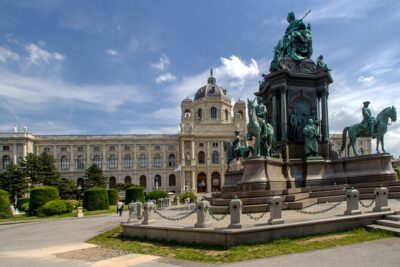
MuseumsQuartier Wien gives you a different kind of reading. Maria Theresa commands the square, flanked by twin museums. It’s a classic Vienna arrangement, powerful presence plus an institutional setting built for public culture.
In the background, one of Vienna’s six FLAK towers appears. These are concrete witnesses to the city’s militarized final months. You are seeing the architecture of air defense right in the same broader zone as cultural institutions. That juxtaposition is exactly why this walk stays valuable even if you think you already know Vienna.
This stop is about 10 minutes and includes free entry as listed for this part of the route. You do not need to commit to a long museum visit to understand why the area matters historically.
Heldenplatz: Anschluss speech ground level, power still visible

Heldenplatz is the stage for imperial ceremony and military pride. Here, the tour makes a hard connection to March 1938, when Hitler’s Anschluss speech took place in this kind of ceremonial setting.
Today, Heldenplatz is framed by parliament, city hall, museums, and the Burgtheater. You get a wide-angle sense of “power, culture, and fragility” built into the architecture and the layout. The lesson is not just what happened in 1938, it’s how easily a public square can be repurposed.
This stop runs about 15 minutes. It gives you time to look at the whole composition, not just one plaque. If you enjoy understanding how space shapes politics, you’ll likely find this one of the most memorable stops.
The Hofburg palace-city and Vienna’s slow shift from monarchy to republic
Then you move to the Hofburg. Think of it as a palace-city, used for power for seven centuries. The tour frames it across eras, from dukes to emperors, and later to the seat of Austria’s modern presidency.
Even without going inside, you can understand why Hofburg matters. It’s not one moment in time. It’s layers. Vienna kept the shell of authority and changed the occupant and the meaning.
There is also a quick in-between moment where you notice how imperial facades meet ecclesiastical grandeur and today’s luxury boutiques. That’s not just shopping talk. It’s a reminder that Vienna’s identity has always mixed ceremony, commerce, and spirituality, side by side.
This stop is about 15 minutes. It works well after Heldenplatz because it expands the focus from a specific propaganda moment to a longer arc of political transformation.
Judenplatz Nameless Library: quiet, essential, and specific
One of the most important stops is Judenplatz Holocaust Memorial, the Nameless Library. The site connects directly to the medieval Jewish community that was destroyed in 1421.
Then comes the memorial’s specific scale. It commemorates 65,000 Austrian Jews murdered in the Shoah. This is not a long stop, about 15 minutes, but it is an essential one. The tone of the tour changes here, and it should. This is where the WWII story becomes personal and numbered, not abstract.
If you’re sensitive to heavy topics, plan for this moment. Wear comfortable shoes, and give yourself a second to look around the square before you focus on the memorial itself. It helps you absorb the setting and not just the facts.
Plague Column and St Stephen’s Cathedral: recovery, crisis, and scars
Colonna Della Peste, also called Pestsaule, is the Plague Column. It represents Counter-Reformation in marble and uses art and devotion to reclaim a city after crisis.
That historical echo matters. WWII is the main theme, but the tour shows you that Vienna has been forced to rebuild after serious shocks before. When you see this column after the Holocaust memorial stop, it reads as a longer pattern of memory, faith, and survival through art.
This segment is quick, about 5 minutes, and is listed as free entry.
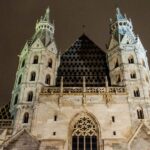
Finally, St. Stephen’s Cathedral closes the walk. It’s Vienna’s Gothic heart, and it’s also a wartime scar. In April 1945, parts of the cathedral burned when looters set fire to nearby shops. The detail is heartbreaking because it shows how a city can suffer not only from bombs but from breakdown and opportunism.
This stop runs about 10 minutes. Even if you’ve admired the cathedral from afar before, seeing it in this WWII postwar frame gives it a different weight.
How the price works for a private group
The price is $342.40 per group, up to 10 people, for about 3 hours. That’s not cheap if you’re traveling solo, but it can be good value if you’re splitting costs with a few people. For example, if you have 4 people, you’d be looking at about $86 per person; with 2 people, about $171 each. Your math will depend on your group size, but the private structure is the value lever.
What you get for that money is not only a guide. You get a licensed Austria guide who comes from your doorstep or pier or train station with hotel pickup. You also get a route design that ties multiple major sites together in a single half-day window, which saves time you would otherwise spend figuring out transport and sequencing.
Many stops are listed as free entry on the route. That means you’re paying mostly for interpretation and connection, not for a stack of paid admissions.
This is also a tour you can actually use. The route gives you enough orientation that you can return later for longer looks, without feeling lost.
Who should book this Vienna private highlights history walk
This is a strong fit if you want:
- A guided story of WWII and postwar Vienna, not just a list of landmarks
- A route that mixes palace views, memorials, and public squares
- Help moving around, including a short tram ride on the Ringstraße
- A private group setting where your guide can adapt pace and focus
It may be less ideal if:
- You want a lot of indoor museum time. This is a walking and looking tour, with stops planned around the city’s landmarks and memorial sites.
- You struggle with extended time on your feet. The tour asks for moderate physical fitness.
Should you book it?
If you care about how Vienna’s architecture and public spaces connect to the 20th century, I’d book this without hesitation. It’s private, organized, and designed for meaning, not just sightseeing.
Choose it especially if you like stories with sharp context. Belvedere’s panorama plus Heldenplatz’s Anschluss connection, then the Nameless Library and wartime scars at St. Stephen’s, that combination makes Vienna’s WWII and postwar era feel real instead of distant.
One last practical tip: bring comfortable shoes and dress for changeable weather, because this is a walking route with outdoor stops. If you want coffee, plan it during natural breaks or at a nearby stop your guide suggests, since the tour pacing is built to keep things moving.
FAQ
How long is the Vienna WWII and Post War Highlights walk?
It runs for about 3 hours.
How much is the tour, and how big is the group?
The price is $342.40 per group, for up to 10 people.
Is this a private tour?
Yes. Only your group participates.
Do you offer hotel pickup?
Yes. Hotel pickup is included. Hotel drop-off is not included.
Where does pickup happen?
The guide meets guests at all hotels and vacation rentals in town, Reichsbruecke pier, or train stations like Vienna Hbf and Vienna West. Other meeting points can be arranged, and there is also a specific meet point for A’Rosa at Handelskai 265, 1020 Wien.
What time does the tour start?
Tours start at 09:30 and 14:00.
Can I cancel for a full refund?
You can cancel up to 24 hours in advance for a full refund, and cancellations made less than 24 hours before the start time are not refunded. Service animals are allowed, and pets are not permitted in certain areas visited.
More Vienna Walks, Step by Step
- Vienna: Guided Walking Tour of City Center Highlights
★ 4.7 · 4,989 reviews - Vienna: Vienna Central Cemetery Guided Walking Tour
★ 4.8 · 3,307 reviews - Vienna: Guided Walking Tour of City Highlights & Hidden Gems
★ 4.9 · 2,180 reviews - Vienna: Viennese Underworld Guided Walking Tour
★ 4.7 · 1,865 reviews - Vienna: World War II Historical Walking Tour
★ 4.8 · 1,772 reviews
More Tour Reviews in Vienna
- Vienna: Vivaldi’s Four Seasons Concert in Karlskirche
★ 4.7 · 14,951 reviews - Vienna: Schönbrunn Palace & Gardens Skip-the-Line Tour
★ 4.7 · 7,739 reviews - Vienna: Light of Creation Votive Church Immersive Light Show
★ 4.8 · 6,779 reviews - Vienna Spanish Riding School Guided Tour
★ 4.7 · 6,765 reviews - Vienna: Classical Concert in the World-Famous Musikverein
★ 4.6 · 6,673 reviews
Yours Alone Across Vienna
- Vienna: Private Walking Tour with a Local Guide
★ 4.6 · 1,420 reviews - Vienna: Private Walking Tour with a Guide
★ 4.7 · 962 reviews - Vienna: Wine Tasting Experience in a Private Wine Cellar
★ 4.8 · 413 reviews - Private Day Tour Trip Salzburg Hallstatt and Melk from Vienna
★ 5.0 · 388 reviews - Private Day Tour of Hallstatt and Salzburg from Vienna
★ 5.0 · 263 reviews
Recently Added Around Vienna


Private Vienna City Tours, compared.
 ★ 4.6Private Walking Tour with a Local GuideFrom $551,420 reviews
 ★ 4.7Private Walking Tour with a GuideFrom $55962 reviews
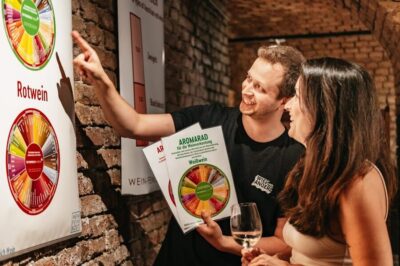 ★ 4.8Wine Tasting Experience in a Private Wine CellarFrom $22413 reviews
 ★ 5.0Private Day Tour Trip Salzburg Hallstatt and Melk from ViennaFrom $930388 reviews
 ★ 5.0Private Day Tour of Hallstatt and Salzburg from ViennaFrom $919263 reviews
 ★ 5.0Private Hidden Vienna Walk — Stories Behind Quiet CornersFrom $344137 reviews
 ★ 5.0Vienna at First Glance a Private Walking Tour for First TimersFrom $344131 reviews
 ★ 4.5Vienna Private Walking Tour with a LocalFrom $58131 reviews
Browse the lists this tour appears in